
by trinkarav
Share

A large double trunked Cherry was leaning into three tall dead ash, the roots of the cherry rotting away. The entire group hanging over a one of our Yurts. I studied it for days, thinking of ways to get them down. I couldn’t find a safe solution and the tree service arrived the next day. Two Cherokee, one older man, small and light, worked the Bobcat, the other, tall with a pointed beard, worked the long chainsaw. The bobcat was small and compact, outfitted with a bulldozer and a long arm with a tree grabber on the end. They worked their way in through the low growth tangle of bushes with systematic precision to get the machine in position under the leaning trees. They put the bucket of the grabber up against the heavy trunk of the cherry and pushed the trees away from the yurt. In a few hours all the ash was down along with the cherry: the small area of forest was transformed – the long trees laid out in a tangle on the ground. Technology and the foresters’ skills had solved our problem. But something felt wrong, out of whack. What if I had approached those trees with an ax and maybe a handsaw. I thought of the ancient people who had inhabited these forests and how they might have handled the situation. Would there have been a better outcome without these modern technologies? The impact on the integrity of the forest would certainly have been less violent. My relationship with those trees would have been closer had I worked the scene with hand tools, taken the time – taken the risk.
Like in most areas of our lives, in painting and drawing there are new ways of solving the problems. Photographic and computer programs can give us multiple options. Technology has come a long way from the optical use of mirrors and projection, the old secrets of the artist, used by some artists in the past. There are things to make it easy. But there is something about difficulty. There is something about getting in close with your hands. There is something about the hand-made – something we are losing.
Jack Lord, the writer, sat for a portrait by Alberto Giacometti. It took a long time. He ended up writing a book about the experience. He was amazed and sometimes horrified watching Giacometti wipe out what he had done, and begin again, over and over. He could not understand what the artist was looking for as he wiped out what appeared to the sitter to be powerful portraits. When he asked, Giacometti said he just wanted to paint what he saw. John Berger, pulling from his personal experience of drawing, wrote: “Nothing else in the world quivers with such complexity as the living human face, and its quivers are like waves crossing the sea of a lifetime.” Getting in close is a whole new world.
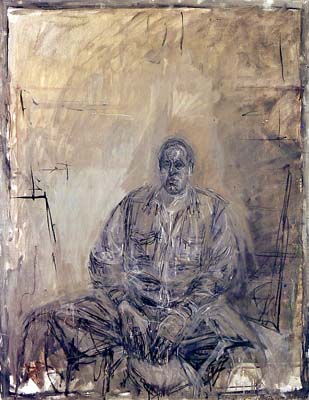
Alberto Giacommetti
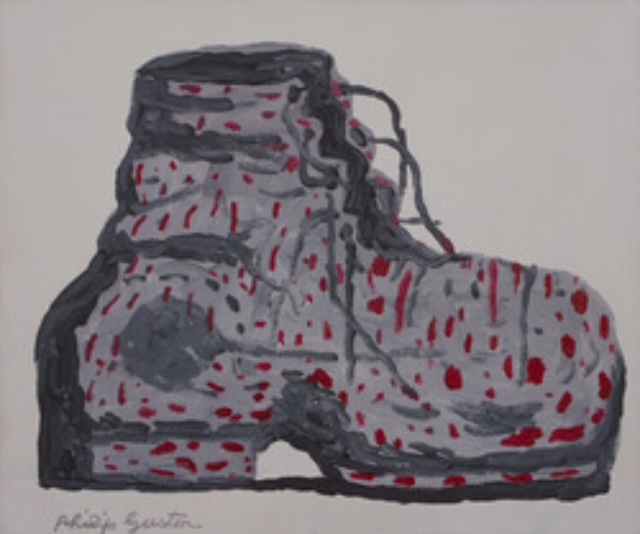
Philip Guston
Philip Guston late in his life as a painter, wrote to his friend Ross Feld.
“The nervousness of the maker is what one has – very little else – and even the “else” is rancid – like old seaweed clinging on. Advice to myself – make no laws. Do not form habits. You do not process a style – you have nothing, finally but some “mysterious urge” to use the stuff – the matter….” 2
His practice was restricted to hand, eye, pen and paper. All technology, the history of drawing and even his personal life of working with these materials, were no help – they were rancid bits of seaweed clinging on – to be discarded, scraped off. It is a strange and stubborn stance. No interest in holding the pencil up to measure the proportions, no technique to serve the task. It was as if he was making himself look for the first time upon the boot – as if he was the first person to make a drawing. It was a search for innocence, an encounter free from history and culture. He was working to get in close – just him and the boot he was drawing. Gabrielle Palcotti living in the sixth century wrote; “Art is a remedy for the defect of distance.” – maybe we could use a dose of that.
Our minds have a distance-making function. It is built in. The order we create out of the flow of information coming to us from the vibrational energies of the universe, becomes the reality we inhabit. When we identify a tree, we separate from the experience of being with that tree. Our minds are not designed to keep us in close attunement to the vibrations of the world we live in. But there are doorways to seeing past the separation we create for ourselves. This is what Giacometti and Guston were doing in their work: it is as though they are taking an axe to deal with those trees. It is easy to see the cost of separation caused by our use of technology to our environment and our relationships with each other. We lose our sense of belonging and our connection to each other and the world around us.
We talked with the two forestry workers about their ancestors. The older man said he had a box of papers handed down to him from his grandmother. He kept it shut because the documents were so fragile. He talked of his grandfather working the skyscrapers in New York, walking the narrow girders high up above the city – no safety ropes, no harnesses – just open sky all around. He said you couldn’t look down – you couldn’t do it if you looked down. The conversation swung back to the Bobcat – how he preferred a different model – this one was awkward – how you can get them second hand with a full warranty. Yes, we want one for the farm – that is an old dream – almost a running joke – that kind of money. Our minds in full tilt from the wonder of those Cherokee construction workers silhouetted against the Manhattan sky, caught in those old photos – legends, heroes now – star athletes from the history of construction – back down to imagining what life would be like on the farm with our own Bobcat. The old man’s eyes lit up as he gave his recommendations and shared his knowledge. He worked that Bobcat like it was an extension of his own body – there was even a softness and subtlety in the way he got that machine to brush things aside or select a particular limb to grab and pull. There is an effortlessness in the strength of the machine – no hesitancy in how it grabs and lifts. The metal pistons are well oiled and smooth – the leavers in the cab are finely calibrated to open and turn the grabber at the end of the arm. A move of the hand on the leaver becomes an iron grip on the trunk – an arm breaking, trunk breaking grip. You can pull those small trees out by the roots – the sounds of cracking and snapping echo in your bones. It is a long dance, this dance with technologies; seductive and complex. It is a long way from an axe to a Bobcat.
There is a saying in the tribes of Papua New Guinea: “knowledge is just a rumor until it lives in the muscle.” 6 Both Alberto Giacometti and Philip Guston, like the Cherokee with the Bobcat, had plenty of knowledge in the muscle. It gets there in the daily doing – the handling of materials – the grip of the pencil, the pinch into the clay – that close in contact where the connections catch hold – where thought turns physical and the line comes alive – the clay starts to hold energy and become animated. This is the place they could trust – ground on which they could stand. Out of the persistent ritual, the daily task, the scheduled sittings, a different conversation creeps in. It becomes an agitated, cranky kind of meeting with spirit. You can’t sit with someone, watch someone for that length of time without coming into contact with their spirit. Not if you are Giacometti. The problem is you can’t draw that any easier than you can draw light around the eyes. Maybe it is the same problem. They are inseparable. It all has to be found, a residue that shows up despite your efforts – right there when you are about to give up – an unexpected gift. Something you must honor – a bridge between the living and the dead.
I think of those aging documents in the box the old man had inherited from his grandmother. The slow deterioration of the thin paper – these messages from past lives – maybe letters or official documents, possibly a newspaper article. He will give them to his grandchildren, he said. Who knows what will become of them. Like his skill with the Bobcat, his knowledge of the felling of trees, maybe there are stories to pass on or a turn of phrase he liked to use, that will stick in memory, become part of what he leaves behind. He had said about those construction workers high on the iron girders, it wasn’t that you didn’t look down, it was that you looked up. You held yourself in the sky above you, not the air below you. You elevated your body to that height so the girder below your feet was the ground. Below that was of no concern. You inhabited what was in front of you and the great dome of the sky above. You never call up to a man on a girder above you – make him look down. There is an old Ojibway saying; “sometimes I go about pitying myself and all along my soul is being blown by great winds across the sky.”9 Look up – good idea. Go where the soul is.